



e-CVT vs. CVT Transmission: What’s the Difference?
Shopping for a hybrid vehicle means encountering transmission terms that can sound confusing at first glance. You’ve probably seen CVT and e-CVT mentioned in specifications at Sport Mazda North, but understanding what separates these technologies helps you make a smarter buying decision. Both aim to improve fuel economy and performance, yet they achieve these goals through distinctly different mechanical approaches.
Understanding CVT Transmission Technology
The continuously variable transmission represents a departure from conventional automatic transmissions that use fixed gear ratios. Instead of shifting through distinct gears, a CVT provides infinite variability within its operating range. Your engine can stay at its most efficient RPM regardless of vehicle speed, which traditionally translates to better fuel economy compared to standard automatics.
How Traditional Belt-and-Pulley CVTs Work
A conventional CVT uses two cone-shaped pulleys connected by a metal belt or chain. As one pulley expands, the other contracts, changing the effective gear ratio seamlessly. The belt rides higher or lower on each pulley depending on load and speed requirements, keeping the engine operating within its sweet spot for power and efficiency.
This belt-and-pulley arrangement allows the transmission to find the perfect ratio for any driving situation. Whether you’re accelerating from a stop, cruising on I-4, or climbing a hill, the CVT adjusts continuously rather than in steps.
Common Applications and Limitations
Many mainstream manufacturers have adopted CVT technology across their lineups, particularly in compact cars and crossovers where fuel economy matters most. Nissan, Subaru, and Honda all use CVTs extensively in non-hybrid models.
However, traditional CVTs come with notable drawbacks. The most common complaint involves what drivers call the “rubber band effect,” where engine RPMs rise during acceleration but the sensation of forward momentum lags behind. Reliability concerns also persist, as the belts experience wear over time. Common issues include cracks, glazing, fraying, and loss of flexibility leading to slipping or belt failure. Replacement costs for failed CVTs can be substantial, sometimes approaching the value of older vehicles.
What Is an e-CVT Transmission?
The e-CVT full form in cars stands for electronically controlled continuously variable transmission, but that name can be misleading. Despite sharing “CVT” in its name, an e-CVT operates through an entirely different mechanical system. This transmission type was developed specifically for hybrid vehicles, where coordinating gasoline engines and electric motors requires precise power management.
How e-CVT Technology Differs Mechanically
An e-CVT eliminates belts and pulleys entirely, instead using a planetary gearset combined with motor-generators. The central component is the Power Split Device (PSD), a single planetary gearset linking the gasoline engine, MG1 (motor-generator one), and MG2 (motor-generator two). This arrangement can blend or separate power sources as needed without friction components to vary ratios.
The planetary gearset acts as the heart of the system, with the sun gear, ring gear, and planet carrier each serving different roles. MG1 connects to the sun gear, MG2 to the ring gear, while the carrier links to the engine. By controlling the speed and direction of the electric motors, the system can infinitely vary the relationship between engine speed and wheel speed. The engine spins at a rate suitable for maximum efficiency, independent of vehicle speed. This creates seamless acceleration without the wear-prone elements that plague conventional CVTs.
The Role of Electric Motors in Power Delivery
Electric motors in an e-CVT actively manage the split between electric and gasoline power, charging the battery when appropriate and delivering instant torque when you need acceleration. MG1 primarily generates electricity to charge the battery or power MG2, while MG2 directly drives the wheels. This dual-motor setup allows the vehicle to operate in pure electric mode at low speeds, gasoline-only mode at highway speeds, or blended mode when maximum power is needed.
The result is remarkably responsive acceleration without lag. When you press the throttle, electric motors deliver immediate torque while the gasoline engine ramps up to its optimal operating range. This instant response makes e-CVT hybrids feel quicker off the line than their horsepower numbers might suggest, particularly in stop-and-go North Orlando traffic.
e-CVT vs CVT: Breaking Down the Key Differences
Understanding the distinction between CVT vs e-CVT comes down to examining their fundamental operating principles. Both eliminate traditional gear shifting, but they achieve this goal through radically different hardware. A conventional CVT is essentially a more advanced automatic transmission, while an e-CVT represents a hybrid-specific power management system that happens to produce CVT-like smoothness.
Mechanical Design and Reliability
Traditional CVTs place significant stress on their belt or chain components, particularly during hard acceleration or when pulling heavy loads. Over time, this creates wear patterns that can lead to slipping, shuddering, or complete failure. Many manufacturers specify CVT fluid changes every 30,000 to 60,000 miles to combat these issues.
The e-CVT design sidesteps these problems entirely. With no belts to stretch or wear, and no clutch packs to burn out, the transmission experiences far less mechanical stress. The planetary gears are bathed in lubricant and operate with minimal friction, while the electric motors contain few moving parts compared to conventional transmission components.
| Aspect | Traditional CVT | e-CVT |
| Core Mechanism | Belt and pulley system | Planetary gearset with electric motors |
| Belts/Chains | Yes (prone to wear including cracks, glazing, and fraying) | No belts or chains |
| Reliability | Belts experience wear over time, leading to potential performance issues | Lacks high-wear components, offering durability advantage |
This mechanical simplicity translates to fewer maintenance requirements and greater long-term durability. Real-world evidence supports this: engineers examining an HF45 e-CVT from a hybrid Ford Escape NYC taxi with 450,000 miles reported the internal parts “looked perfect, and would have been good for many more miles.” Hybrid vehicles with e-CVTs routinely exceed 200,000 miles without transmission trouble, something that remains uncommon for belt-driven CVTs.
Driving Experience and Responsiveness
The difference between CVT and e-CVT becomes immediately apparent behind the wheel. Traditional CVTs often hold engine RPMs steady during acceleration, creating that disconnected rubber band sensation. Some manufacturers program in fake shift points to make the experience feel more conventional, but these simulated shifts can feel artificial.
E-CVTs deliver power more naturally, with acceleration that feels linear and immediate. The instant torque from electric motors fills in any gaps while the gas engine reaches its operating range, eliminating the lag that plagues conventional CVTs. Engine RPMs still rise during hard acceleration, but the sensation matches the forward thrust more intuitively.
Fuel Efficiency and Performance Benefits of e-CVT
The electric CVT transmission excels at maximizing fuel economy through intelligent power management. By allowing the gasoline engine to shut off completely at stops and during low-speed cruising, e-CVTs eliminate idling fuel consumption entirely. The system calculates the most efficient power source for current conditions, running in electric mode when possible and firing the engine only when battery charge depletes or power demands increase.
Highway driving reveals another efficiency advantage. The e-CVT can lock the engine into its most efficient operating range while cruising at steady speeds, with the electric motors providing gentle assists to maintain momentum. The result shows up at the pump, where e-CVT hybrids typically achieve 40 to 50 MPG in combined driving, compared to 30 to 35 MPG for comparable CVT-equipped non-hybrids.
Performance benefits extend beyond efficiency. The combined output of gasoline engine and electric motors gives e-CVT vehicles surprising punch for passing and merging. A hybrid with 200 total system horsepower often feels quicker than a conventional car with similar power because torque arrives instantly from the electric motors.
e-CVT Transmission in Mazda Hybrid Vehicles
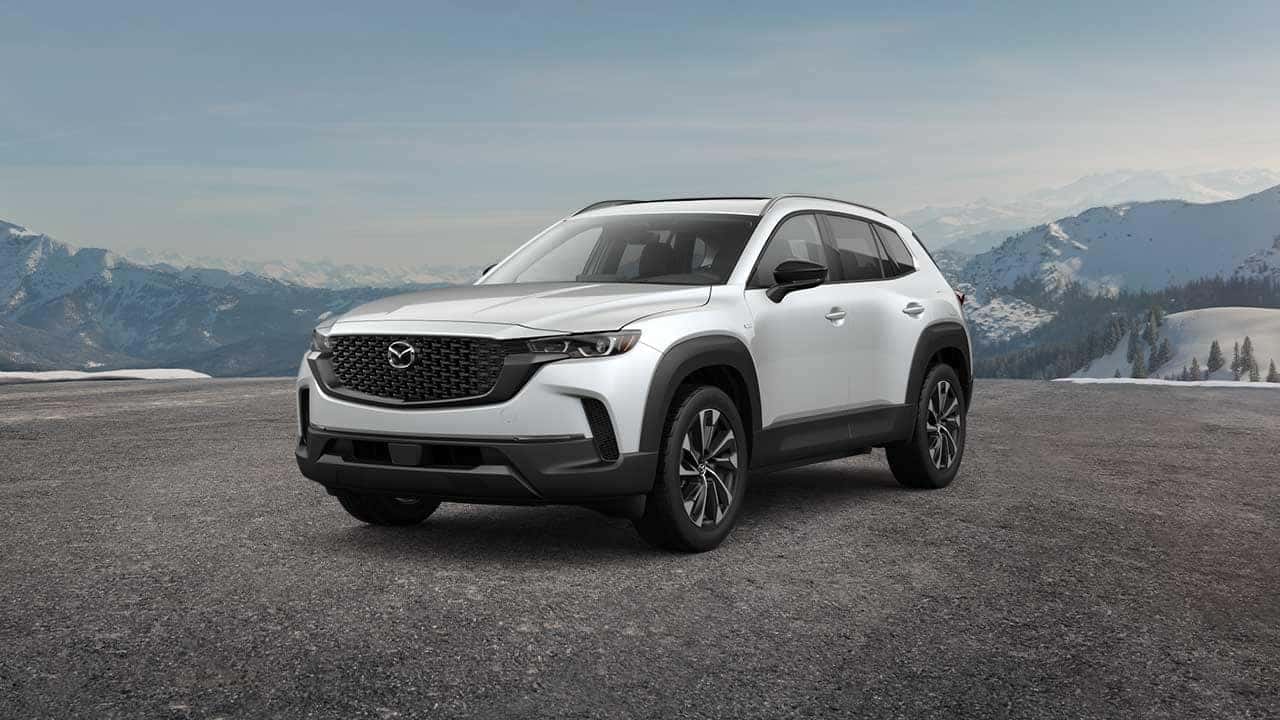
Mazda’s adoption of e-CVT technology represents a strategic partnership with Toyota, leveraging the proven Toyota Hybrid System (THS). The 2025 Mazda CX-50 Hybrid features e-CVT through this collaboration, with a powertrain that includes a 2.5-liter naturally aspirated four-cylinder engine, electric motors, hybrid EV battery pack, e-CVT, and e-AWD. This allows Mazda to offer competitive hybrid options while benefiting from decades of development and millions of miles of real-world testing.
What sets Mazda’s implementation apart is the integration with the brand’s driving philosophy. Rather than prioritizing efficiency above all else, Mazda calibrates the e-CVT for responsive handling and engaging acceleration. The transmission management system works with Mazda’s G-Vectoring Control to enhance stability during cornering, while throttle mapping provides the direct connection between pedal input and acceleration that Mazda drivers expect.
The reliability that Toyota’s e-CVT systems have demonstrated gives Mazda hybrid owners confidence in long-term ownership. These transmissions have proven themselves in taxis, ride-share fleets, and high-mileage commuter vehicles worldwide. Mazda’s quality standards add another layer of assurance, with rigorous testing ensuring the e-CVT performs flawlessly through Central Florida’s heat and humidity.
Maintenance and Long-Term Ownership Considerations
e-CVT Maintenance Requirements
The e-CVT transmission reliability record speaks for itself through data from hundreds of thousands of hybrid vehicles. Routine maintenance for an e-CVT typically involves periodic fluid changes at longer intervals than conventional transmissions, often 60,000 to 100,000 miles depending on manufacturer specifications. The fluid primarily lubricates the planetary gears rather than managing friction components, so it doesn’t degrade as quickly.
Beyond fluid changes, e-CVTs require minimal attention. There are no belts to replace, no clutches to adjust, and no bands to tighten. The electric motors are sealed units that require no maintenance during normal vehicle life. Our service center handles routine hybrid maintenance following manufacturer specifications.
Cost Comparison and Long-Term Value
Compare this to CVT maintenance schedules, which often call for fluid changes every 30,000 to 50,000 miles and potential belt replacements at higher mileages. Repair costs for failed CVTs can range from $3,000 to $8,000 depending on vehicle and whether you choose rebuilding or replacement. E-CVT repairs, by contrast, rarely occur outside of accident damage or extreme neglect.
The cost equation favors e-CVTs over time despite higher initial hybrid pricing. Lower maintenance requirements, better fuel economy, and greater reliability translate to reduced total ownership costs. For buyers planning to keep vehicles beyond 100,000 miles, the e-CVT’s durability advantage becomes particularly valuable.
Experience Mazda’s e-CVT Technology at Sport Mazda North
Reading about transmission technology only tells part of the story. The real difference between e-CVT and CVT becomes clear when you drive both systems back-to-back. Sport Mazda North maintains a selection of Mazda hybrid models equipped with e-CVT transmissions, giving Longwood, Altamonte Springs, and Sanford area drivers the opportunity to experience this technology firsthand. Contact us at 321-300-7266 to schedule your test drive.
We take time to explain how e-CVT systems work, what maintenance they require, and how they perform in real-world driving conditions throughout Central Florida. Test drives on local roads let you feel the instant response, smooth acceleration, and quiet operation that make e-CVT hybrids appealing.
Our service department staffs technicians trained in hybrid system maintenance and repair. We handle routine service for Mazda hybrids using genuine parts and following manufacturer specifications.
Visit us at 400 N US Highway 17-92 in Longwood to explore Mazda’s hybrid lineup and discover how e-CVT technology delivers the balance of efficiency and performance you’re looking for.
0 comment(s) so far on e-CVT vs. CVT Transmission: What’s the Difference?