



Mazda CX-5 Cargo Space | All Model Years
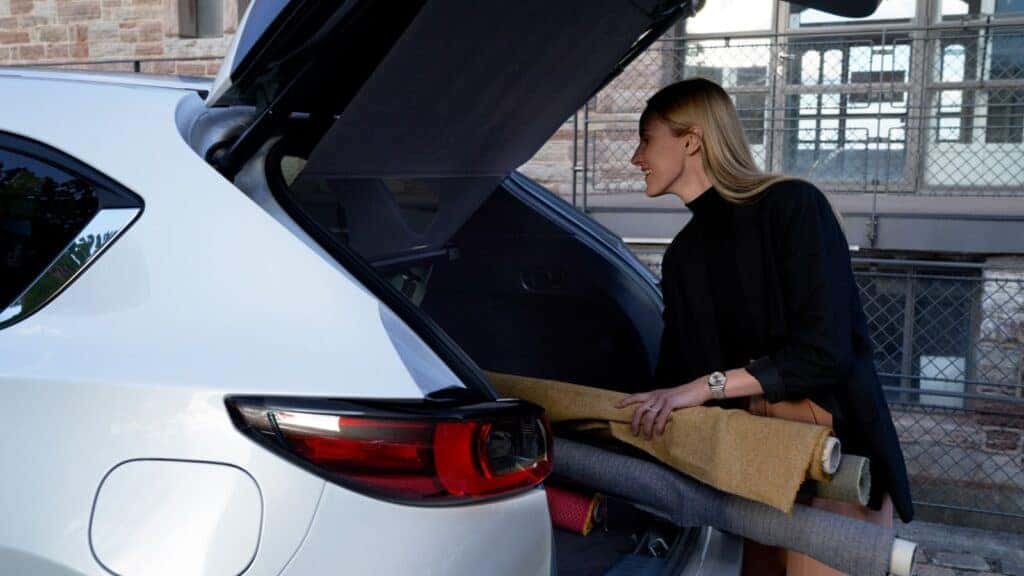
Shopping the Mazda CX-5 and want the straight facts on cargo room—year by year? You’re in the right place. Below, we document every model year from the newest first, call out when measurements changed, and group years that share identical specs. Figures come from Mazda’s own specifications where available, and we flag any model years where official U.S. cargo numbers haven’t been published yet.
2025–2022 Mazda CX-5 (same measurements)
For 2022 through 2025, the CX-5’s cargo capacity is essentially unchanged when measured to current SAE/EPA practices:
-
Behind second row (seats up): ~30.8 cu ft (871 liters)
-
Maximum (rear seats folded): ~59.3 cu ft (1,680 liters)
These values are shown in Mazda’s official spec decks and brochures (Canada/US documents list liters and/or cubic feet; 871 L ≈ 30.8 cu ft, 1,680 L ≈ 59.3 cu ft).
Notes for shoppers: In this generation, some dealer and media sites may quote 30.8–30.9 cu ft and ~59.3–59.6 cu ft due to rounding and floor-panel position during measurement. Mazda’s 2024–2025 spec decks also break out added dimensions like width at floor (approx. 56–57 in) and length to the first row, which helps visualize real-world loading.
2021–2017 Mazda CX-5 (same measurements)
The second-generation CX-5 (2017 launch through 2021) carries the following certified cargo specs:
-
Behind second row (seats up): 30.9 cu ft
-
Maximum (rear seats folded): 59.6 cu ft
Mazda’s features-and-specs PDFs for 2017, 2018, 2019, and 2021 confirm these identical figures across the span.
Why the change from earlier years? The 2017 redesign prioritized cabin quietness, material quality, and rear-seat comfort, with a slightly more tapered cargo area than the first generation—hence the reduction from the prior 34.1/64.8 cu ft values.
2016–2013 Mazda CX-5 (same measurements)
All first-generation CX-5 model years (2013–2016, including the 2016.5 update) share the same core cargo numbers:
-
Behind second row (seats up): 34.1 cu ft
-
Maximum (rear seats folded): 64.8–65.4 cu ft (Mazda lists both 64.8 cu ft for 60/40 folded and 65.4 cu ft for the 40/20/40 configuration)
These values appear consistently in Mazda’s brochures and specification decks for 2013, 2014, 2015, and 2016.
How to Use These Numbers When You’re Comparing
-
Floor-panel position matters (2022–2025): Mazda’s recent spec decks distinguish measurements with the floorboard up/down. That’s why you’ll see small variances (30.8 vs. 30.9; 59.3 vs. 59.6). If you’re cross-shopping lists online, make sure the floor position and methodology match.
-
Payload shape counts as much as volume: Width between the wheel housings and the opening height determine whether large items fit cleanly. Mazda publishes these granular dimensions (e.g., ~41 in between wheel housings, ~32 in cargo height), which can be more telling than volume alone for strollers, coolers, or club bags.
-
Generational breakpoints: If maximum volume is your priority, the 2013–2016 models provide the largest quoted numbers; if you want the newest chassis and cabin, 2017–2025 models trade a few cubes for refinement.
Conclusion
Across three CX-5 generations, Mazda’s compact SUV has offered practical, square-shouldered space with thoughtful dimensions that make daily loading simple. First-gen models (2013–2016) post the highest headline numbers (34.1/64.8–65.4 cu ft), the second-gen (2017–2021) stabilizes at 30.9/59.6 cu ft, and the latest run (2022–2025) measures about 30.8/59.3 cu ft under current protocols. If you want tailored guidance—what fits, which years align with your use case, and how trim features like a power liftgate or roof rails change everyday usability—our team at Sport Mazda North is happy to help you pick the right CX-5 and set up a test load with your gear.